
Teplice
When the strolling stops

New here? Start with Johann Gottfried Seume Stroll to Syracuse project.
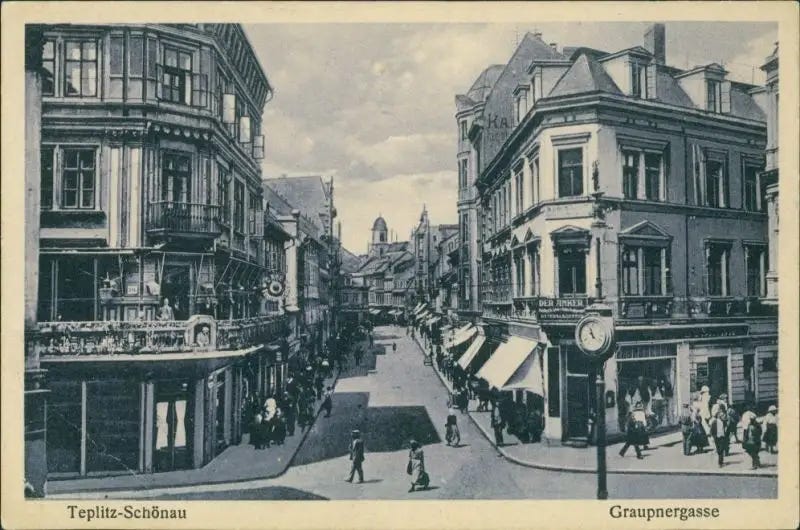
Stage two, stop two.
Teplice is a spa town in north-west Bohemia, set beneath the Ore Mountains, 25 kilometres west of Ústí nad Labem. The town was known in German as Teplitz.
In his 1836 book An account of the most frequented watering places on the continent, Edwin Lee describes the town as follows:
This small town lies about half way between Dresden and Prague, in a fertile valley, bounded on the north-west by the Erzgebirge1, and on the other sides by gently rising hills. It is a clean but not handsome town, most of the streets being narrow; the hotels are, however, numerous and large, the accommodations good, and the walks and drives agreeable. Teplitz has long been a favourite summer retreat for crowned heads, diplomatsr, and persons of rank.
In 1833, 5300 persons used the baths. These consisted, for the most part, of Germans, Russians, and Poles. There are altogether eighty-four baths in Teplitz and Schoenau, independently of those in private apartments. Most patients, after having employed the water for some time, experience a degree of lassitude and indisposition which lasts for a longer or shorter period, but which is generally succeeded by a sensible amelioration of their health.
Seume and Teplice
In 1808, Seume became seriously ill with a kidney and bladder ailment and fell into financial difficulties. He grew increasingly ill, poor and desperate. His many friends, not only in Leipzig, supported him.
In 1809, he unsuccessfully sought a Russian officer’s pension. His friend Christoph Martin Wieland made a second attempt on his behalf, writing to the Dowager Tsarina, whom Seume had met in the summer of 1805.
Advances from the publishers Hartknoch and Cotta made it possible for Seume to take a cure in Teplitz. The Baltic German Baroness Elisabeth von der Recke took him there, and he arrived on 3 June 1810.
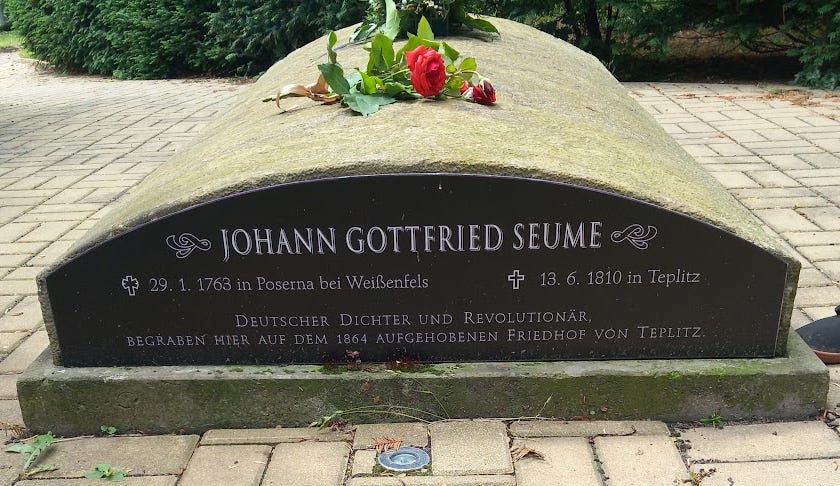
Seume’s kidney disease, which had already prevented his father from reaching old age, worsened abruptly. While he was dying, his tenancy agreement expired and his landlord insisted that he move. Seume had already agreed to do so, but he died on 13 June. Baroness von der Recke was close to him at the time of his death and arranged a dignified burial and a monument in Teplitz.
Three days after receiving news of Seume’s death, Wieland was notified that his application for a pension on Seume’s behalf had been successful.
Seume monument in Teplice


Seume’s grave in Teplice
My time in Teplice
Day One
Arriving on the lunchtime train from Ústí nad Labem, I was immediately struck by the fine arched ceilings of the Neo-Romanesque interior of the train station.


I had a Vietnamese lunch at a nearby restaurant and checked into my Airbnb for an afternoon nap.
In the late afternoon, I wandered through the town to Castle Square.


Over my shoulder, on the right of the building, are the balconies of the hall where three monarchs met in 1813. The plaque on the wall commemorates the meeting:
In the balcony hall of this house in September and October of the year 1813, the Austrian Emperor Franz I, the Russian Czar Alexander I, and the Prussian King Frederick William III discussed together their rise against Napoleon and they closed their alliance pact, which prepared the basis for the political power system in Europe following the Napoleonic Wars.
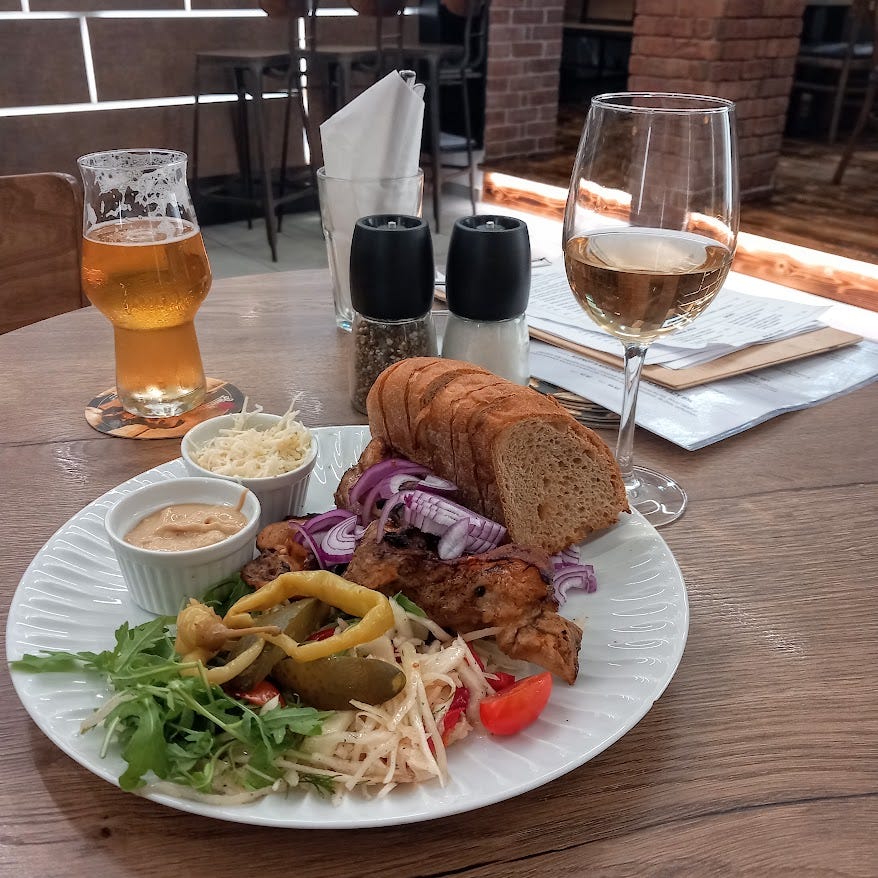
I had dinner and a few glasses of the excellent local white wine in a friendly restaurant called Hospůdka Hlubina.
Day Two
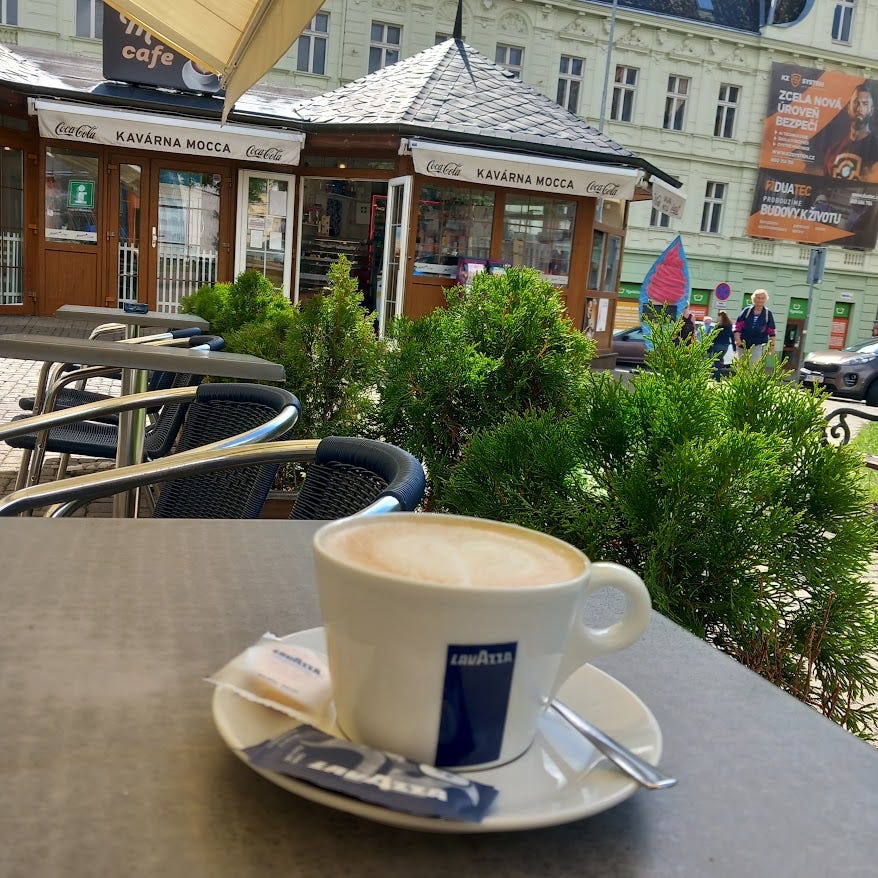
I started the day at Cafe Benešovo in the pleasant square of the same name, where I had a coffee and a slice of cake.
Commemorating Seume
The main reason for my visit to Teplice that day was to participate in the commemorative events for the 216th anniversary of Seume’s death.
I met up with members of the Seume Society for lunch, after which we set off to Seume’s grave in a nearby park.
At the graveside, three Czech friends of the Seume Society joined us. Together, we paid our respects, remembered Seume and spoke of a man who stood for freedom, justice and independent thought.


It felt good to be among other admirers of Seume, and I had some excellent conversations. At the end of the ceremony, we said our goodbyes and I made my way to the station for the onward train to Lovosice and Litoměřice.
Previous: Petrovice and Usti Nad Labem
Next stop: Lovosice and Litoměřice
Onwards!
The Erzgebirge, or Ore Mountains, is a 150km-long mountain range stretching along the border of Germany and the Czech Republic.