
In Leipzig
A school, a plaque, a tabernacle

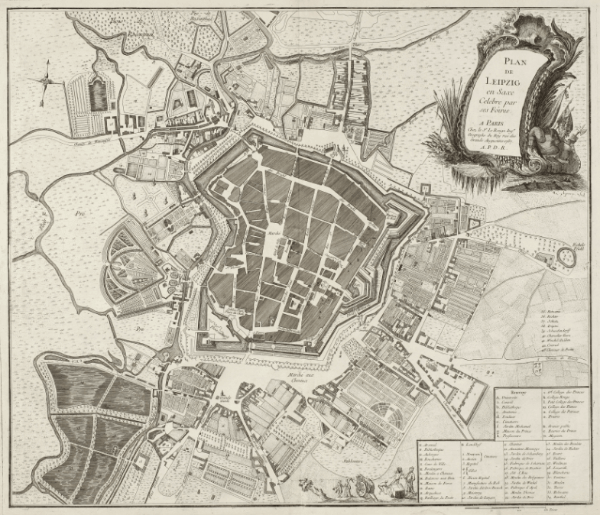
In November, while spending a few days in Berlin1, I took the opportunity for a day trip to Leipzig, the city in which Seume spent half his life. In his Leipzig, one building helped shape him and another gave him shelter.
When, in the evening twilight, I again saw the towers of Leipzig, which I have come to think of almost as a tabernacle for myself, I felt a quickening of the heart beneath my left side, though I kept trying to hold fast to my Stoicism.
— Seume, My Life
I had two goals in mind. First, to see the school, the Nikolaischule2, he attended for a year at the age of 18; second, to see the plaque that marks the location of the building in which he stayed on and off when living in the city.
Leipzig was, and still is, a bookish city of commerce and learning, at the intersection of old trade routes, somewhat aloof from its stately, courtly, baroque neighbour Dresden, the so-called Florence on the Elbe.
Leipzig in the late eighteenth century, Goethe’s little Paris, already a city of height and density: tall houses narrowed the streets, the light reduced by stone buildings, the air busy with shops and crowds. Bach’s3 music seemed to hover over everything.
The Nikolaischule
Prior to enrolling at the Nikolaischule, Seume had excelled in his village and high schools. He memorised the gospels, he conjugated Latin and read Cicero.
The Nikolaischule was a big step up, the school of Leibniz and later on Wagner and Liebknecht. He was excited to be there.
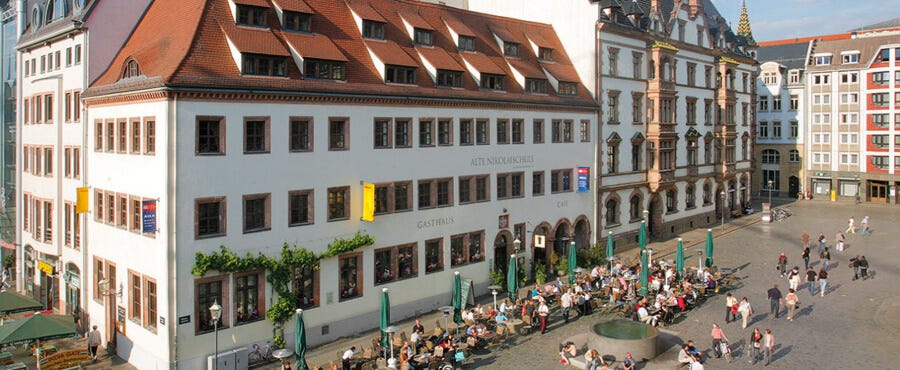
Dissatisfaction with school set in quickly. His room was cold and uncomfortable. He grew tired of theology; he began to have doubts. He clashed with the rector; a tyrant and a miser.
By now something was beginning to ferment fearfully inside me. I realised that as an honest man I could not continue on this path... I revered the Bible and did not refuse entry to its moral parts into my heart. I revered Moses and Christ, but in my own way and not according to the system. Hypocrisy was unbearable to me; I always said only what I truly thought, although of course I did not say everything I thought.
—Seume, My Life
On the bright side, he composed poetry; he was shaken by Werther4. He went to the theatre; he went to concerts. He wrote, he read, he thought.
He lasted a year at the Nikolaischule and began to doubt whether the religious life was really for him. Then, after a final reckoning with the rector, he decided to leave and seek his fortune elsewhere.
I resolved to test my own strength at all costs. That could not happen in Leipzig or anywhere in my homeland. After many inner struggles…I left, without any fixed plan of where or for what purpose. I took my monthly allowance, sold a few books of some value, and after paying off the small debts I inevitably had, I was left with about 9 thalers5. With this…I imagined getting to Paris and looking around to see what might be possible for me there…The rest I reasonably left to fate.
—Seume, My Life
Markt 6
Here I sit again in my little retreat
—Seume
Markt 6 is in Leipzig’s main square. If, like I did on one sunny, mild November day, you look above one of the first tables on the left outside the entrance to the Augustiner am Markt restaurant, you’ll find a bronze plaque, dark against pale stone, dedicated to Seume.
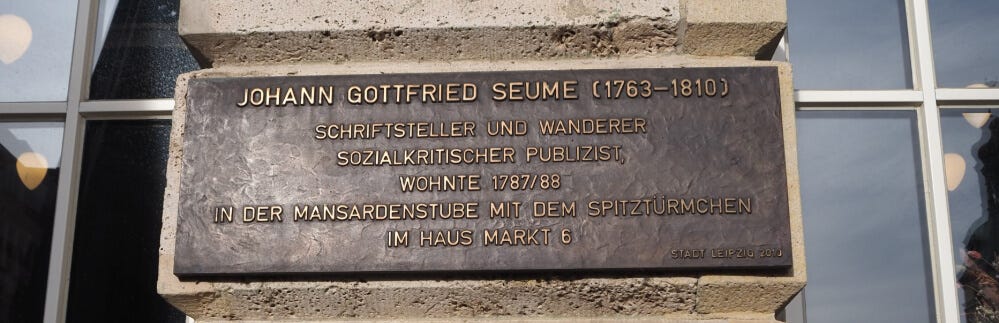
JOHANN GOTTFRIED SEUME (1763–1810)
Writer and traveller
Social critic and publicist
Lived here in 1787–1788
In the mansard room with the small spire
House at Market Square 6
Seume moved into an attic apartment under the roof turret for a year in 1787 after deserting from Prussian military service and again in 1795 after escaping the failed Polish uprising in Warsaw. The turret has since been known as the Seume Tower.


The table under the plaque was empty; I took it. The menu arrived; I ordered currywurst and a litre of beer, and thought of Seume striding across the square from the Nikolaischule, books by Cicero and Virgil tucked under his arm, or returning to his turret after yet another adventure in another land.


The square clattered with cutlery and conversation, the sun shone bright against the blue sky. I lifted my glass and drank to Seume, to his city, and for a day, mine.
“After the aggressiveness and modernity of Berlin, it is a relief to mingle with the quiet, matter-of-fact people of Leipsic,”
- Romantic Germany by Robert Haven Schauffler (1900)
(There’s still some truth to this observation)
As Cantor of the Thomasschule at St. Thomas’s Church, Johann Sebastian Bach provided music for four churches in the city: St Thomas’s, St Nicholas’s, the New Church and St Peter’s.
Johann Wolfgang Goethe - The Sorrows of Young Werther (1774)
About £150 in today’s money (according to Google Gemini)
You look very relaxed, Martin, I trust you’re enjoying your quest. How’s your German?
Somehow the Germans can make even a basic meal like currywurst, chips and beer look great. And the man who took your photo, Wolfgang Fritsche, sounds like he should be a philosopher.